Monday, June 16, 2014

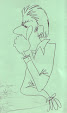
We are all touched by Andres Segovia

I have been playing guitar, or attempting to play it in a fashion, since I was about 12 years old.  My mother tells me that even as a young child, I was drawn to the guitar, fascinated by it.  In other words, on some level, I always wanted to play the guitar, even before I started taking lessons and learning first-hand of its challenges and difficulties.

When I was in college, after years of playing rock music and writing my own songs, I found myself attracted to the intricacies and beautiful mystery of the classical guitar. The classical guitar, then as now, seemed apart from other guitar styles and apart from classical music. One man, especially, has been given a lot of the credit for helping to bring credibility to the modern classical guitar: Andres Segovia.  I learned who he was just barely before he died, in 1987.  My own studies of the classical guitar, if such modest attempts can be called "study," began with Mel Bay's Classic Guitar Method and with a few lessons through extension learning at the University of Texas. Since that time, I tried to practice a few pieces, and bought a nice, handmade classical guitar from the Croatian guitar prodigy Ana Vidovic, but mostly I languished as a classical guitarist, and I also did not do much with my other guitars, being mostly preoccupied with the business of living life and trying to get by.

In the last couple of years, I have picked up the classical guitar again, and tried to pursue it more earnestly, with the help of my current instructor, John Kiefer, who teaches guitar at the community college where I teach writing and literature. With John, I have tried to expand my repertoire, learn new skills, and break old habits.


Concurrent with the new routine, I have been reading more about classical guitarists, including Segovia, Christopher Parkening, and John Williams. In reading the Wikipedia entry on Segovia, I was taken aback by the statement that "practically all living classical guitarists are students of Segovia or students of his students."  This seemed implausible, until I began to research it a bit. I asked my instructor, and he nodded and said that his own instructor was a student of a Segovia protege. A little more removed than suggested by Wikipedia, but still pretty interesting.  Then I discovered, quite accidentally, that my first classical guitar instructor, someone I had only taken a few lessons from -- a Spanish guitarist named Maria Cortes -- had studied with Segovia.  I had found two links to me, an amateur guitarist living in suburban Houston, seemingly far from the influence of Europe and Spain.  Not bad.

Segovia's influence cannot be overstated, perhaps, although music writers have noted that there were other guitarists during Segovia's time (such as Ida Presti) who were just as talented and brilliant.  Yet Segovia had the gravitas, the dedication to the guitar like no other, and he had the studious, romantic image that conveyed something important about the guitar. (It also helped that he kept at it for so long, from the 1930s to1980s, giving continuity to his efforts.) Guitarists working today perhaps think of Segovia as too serious, too shut off from other genres and styles (several recent guitarists have made wonderful hybrid albums with the electric guitar, for instance, something that likely would have made Segovia shudder).  Segovia gave the classical guitar what it needed at the time, in order to be taken seriously by the classical music world, and his contributions made all that experimentation possible. And of course, he continues to, indirectly through his teaching and inspirational legacy, influence all students of the classical guitar.

Saturday, May 17, 2014

Disappearing Culture

In a fine new Salon article, writer Andrew Leonard writes about the changes in music-delivery media, and posits that we will miss 1990s-era CDs much less than we miss LPs and other obsolete forms of music storage. It's an interesting essay, well worth reading in its own right, as Andrew Leonard is one of the better writers over at Salon. His essay got me thinking about what we always miss when new forms of art and new forms artistic delivery (media) emerge. Although there is a resurgence of nostalgic interest in LPs (mentioned in his essay), it seems clear that particular form has become a thing of the past. At their best, albums represented beautifully packaged artistic visions, the aesthetic of the album packaging complementing carefully chosen tracks that presented a complete picture of the musical artist's voice at the time. Album artwork often included compelling photographs as well as details of the recording and reprints of the lyrics. We have lost that complete package, and we have arguably lost something in audio quality (depending on the type of compression used in whatever digital audio file you have), but the consumers have also gained greater accessibility and the ability to buy only the songs we want (although ITunes has also attempted various workarounds on that, with "album only" purchase options).  We have gained something, but we have lost something also. Such is the way with the progress of artistic technology.  I've been reading a biography of Andres Segovia, the great classical guitarist, who had to endure the loss of fine, hand-wound strings to less-expensive, machine-made strings.  To the casual listener, his sound quality never suffered, and strings were made more widely available for all, for a long time. But there's always a trade-off. When sound movies were invented, we lost the delicate art of silent film, yet few today mourn the loss in any serious way. Sound presented an obvious advantage in allowing us to access the rich language of human dialogue and the evocative emotion of music.
Silent films today exist as wistful dreams of a bygone era, beautiful in their own way but relics of the past. The technology of art marches on, and artists and consumers change and adapt in a way that keeps art vibrant and relevant.

Thursday, May 1, 2014

Starbucks

For a creative-project assignment in my American literature class today, one of my students brought ginger-snap cookies and, to wash down the somewhat bitter taste of these old-fashioned treats, a cardboard pot of Starbucks coffee. The cookies were inspired by Ginger Nut, a young office-boy character in Herman Melville's short story "Bartleby, the Scrivener." Although my student didn't realize it, bringing a pot of Starbucks coffee was an especially inspired addition to this project, since the name of that famous coffee chain was taken from a character in another Herman Melville work, Moby-Dick.  (The founders had wanted to call the shop Pequod's, after the ship in Moby-Dick, but were talked out of it by their financial backers. They settled on the name of the level-headed chief mate on the fictional ship.
Not a Starbucks, in Key West,  Florida (original photo)

I have nothing bad to say about Starbucks, though of course it's been a target of criticism for its ubiquitous presence (a store on every corner) and its supposed role in driving out the smaller coffee shops. (Disclaimer: I happen to own some stock in the company.)  But really, how many small coffeeshops were around before Starbucks?  Didn't they really arise as Starbucks spearheaded the entire coffee-drinking trend? I am not a huge fan of the coffee itself, because I prefer a lighter roast on my coffee beans (contrary to the common view, "dark" roasted coffee has nothing to do with strength in terms of caffeine; it's really just about how long the bean is roasted and the flavor of the final brew). Most Starbucks brews require cream to mellow that "slightly burnt" taste.

I like Starbucks because they treat their customers well, and, not coincidentally, they treat their employees well.  They also allow anyone to use their restrooms, as a matter of policy, whether you're a paying customer or not. That's pretty cool.


And that coffee my student brought to class was pretty darn excellent, even if I did have to put some cream in. "I'd prefer not to" put in the cream, but it beats typical office coffee no matter what.

Monday, April 7, 2014

R.I.P. Mickey Rooney

Mickey Rooney, that venerable yet mercurial Hollywood legend who was in movies longer than anyone, the last star to have had roles in silent movies, has passed. Because I teach Mark Twain's novel every semester, I primarily remember Rooney from his role as Huckleberry Finn in MGM's The Adventures of Huckleberry Finn (1939).

While it's easy to criticize this particular version as overly sanitized from our modern perspective, it's also worth noting that nearly every film version of Twain's novel has cleaned up the language and dealt with the issue of slavery in a "family-friendly" fashion, often by awkwardly repackaging the story as a message movie. Rooney's portrayal of Huck as an all-American, freckle-faced mild rebel may not seem very faithful to Twain's more complex vision of Huck, but it remains true to the plucky, generous spirit of the character. Rooney's Huck has a big heart, and it's a pleasure to watch him on screen, even 70 years later, as he energetically bounces from one predicament to another.

Although the obituaries have not paid much attention to this film, focusing instead on his highly profitable Andy Hardy films and musicals with Judy Garland, The Adventures of Huckleberry Finn is worth mentioning as a highly watchable, comical film of its era that, if not a faithful adaptation of the novel, that pays great tribute to Twain's humor and his admiration for the American youthful spirit.  It's no wonder this was the definitive Huck Finn adaptation for decades, a film that people remembered fondly as the first real cinematic vision of Huck. (The first adaptation was actually during the silent era.) Filmmakers have been trying to adapt Huck Finn for the screen ever since, with very little success, as the family-friendly movie genre proves to be too small a box for Twain's complex novel. But at least with Mickey Rooney's version, we get a lovable and suitably adolescent Huck (he's often portrayed as much younger), who looks pretty comfortable smoking a pipe.

Like Huck, Rooney was something of a rebel and an amiable trouble-maker in real life (see the linked obituary above), so perhaps he connected to Huck on some level. Like Huck, this was a guy who was hard to confine, hard to keep civilized in the way that society feels comfortable with.

R.I.P. to Mickey Rooney, who has lit out for the territories, so to speak.

Oh, and this is cool:  My name will forever be linked with Mickey Rooney's, at least in the official IMDB record for his last film, "Dr. Jekyll and Mr. Hyde" (2014).  Just look at my name under the "Producers" heading. 

Friday, November 8, 2013

Blockbuster Busts Out

In case you haven't heard, or in case you're surprised to learn they still had any stores open, Blockbuster has officially decided to close all its corporate retail rental stores. I for one welcome the news, remembering as many others do Blockbuster's awful customer service, its policy of being hard nosed about late fees, and its limited selection and tendency to focus too much on carrying dozens of copies of the latest releases and very few foreign or independent films. (What kind of slogan is "Be kind. Please rewind."?) It's also ironic, of course, that Blockbuster now faces the same fate as the many mom-and-pop neighborhood rental stores it put out of business.

Nonetheless, the story has me feeling nostalgic about the video-rental glory days, physically going to the video store and ritualistically gazing at the empty boxes of available movies, deciding want to rent for a quiet night at home. Physically perusing the shelves at the video-rental store, as opposed to going through endless lists of streaming videos, seemed more like shopping, the promise of the perfect rental remaining tantalizingly just out of sight as you looked at all the available videos, each one a mystery, its contents only suggested by the cover and the names of stars. I used to drive partners mad as I lingered looking at all the different movie boxes. I sometimes wanted to go down every row, see everything that was available, as opposed to just grabbing the first promising video.

With VHS movies in particular, those boxy, worn-out covers often revealed forgotten gems, obscure movies that had only been printed once. I remain nostalgic particularly about the magic of VHS, the first home-rental movie format (if we conveniently forget about Beta, since I never had a Betamax). The movies felt like real movies in those boxy, book-like packages, even if the actual video quality of the movies was substandard and grainy by today's standards (and even in comparison to the resolution of standard TV in those days -- VHS movies always had that strange, cartoonish quality; you knew when you were watching a "video").  But there was something odd and promising about being able to fast forward and scan through movies to find your favorite scenes, something real about the way the video tapes rewound, clicked in the machine, and whirred and buzzed when played. Video tapes also gave us our first opportunity to watch movies at home, at our own leisure, without waiting for a favorite to come back on to TV broadcast.


I remember my last physical video rental, a DVD a friend and I hunted down after a few drinks. It was 2008, and he was determined that I see Superbad, because I hadn't seen it, and so we took a trip to the last of the neighborhood video store holdouts in my area, a store that has since closed down. Streaming video wasn't yet available, at least on my system, so the only real option was to find a video store and find the movie. Video stores gave you that opportunity for adventure, a hunting trip to the local video store to find that movie you had to watch that night. Sometimes you even had to buy the video if it wasn't available for rental.

Now our options seem endless, and the chance for a hunting adventure, a drive to the local video store, seems ridiculous and quaint, just a few years after my last trip. We still have our DVDs and Blu-Rays, of course, but they too will be quickly fading. Soon we will never have to leave the house at all.

Thursday, October 17, 2013

Breakfast

Every one of those flippant online lifestyle articles about how to lose weight always mentions that you should eat breakfast regularly. These articles state, without much variation, that healthy people start their days with a healthy, high-fiber or high-protein breakfast. Attractive and enviable young urban professionals know that eating a healthy breakfast gets your metabolism going and gives you the energy to keep moving, thereby burning more calories throughout the day. Furthermore, these anonymous lifestyle experts suggest, not eating breakfast signals to your body that you are "starving," slowing down your metabolism to conserve energy and that you will overeat at your next meal, scarfing down hamburgers and french fries because you didn't eat a bran muffin for breakfast.

I question the wisdom of the this particular advice, and it's not because I'm one of those people who doesn't like breakfast or normally skips it. I think the lifestyle editors like to offer this advice because they know so many people don't eat breakfast, so it seems like an easy thing to say, easy to say and easy to dismiss, since most people will continue to eat breakfast or not. (Most people who skip breakfast or aren't interested in it probably are waking up too early and just aren't ready to eat.)

The thing is, and I know this is anecdotal, non-scientific evidence, most of the skinny people I know do not eat breakfast at all. That's it.  So maybe I'm a conspiracy theorist, but this "you need to eat breakfast" thing seems like a nice way for skinny people to keep everybody else fat. Whatever the motivation, there are so many different kinds of advice for losing weight and dieting because nothing works exactly the same way for everyone. (It's sort of like all the different types of cold remedies, hangover cures, and headache pills. If one thing worked for everyone all the time, that would be the solution.) Yes, burning more calories than you consume always works theoretically, but not in exactly the same way for everyone; you must also consider factors of age, hormones, gender, and metabolism.

Here is how author Gore Vidal said he started his day: "First coffee. Then a bowel movement. Then the muse joins me."  I rather like that breakfast suggestion as a bit of writing advice.

The word "breakfast" (break-fast), by the way, comes from the idea of "breaking the fast" that you endure while sleeping. Thus, when you awake at a natural time, after sleeping sufficiently, you will often be hungrier than you are at any other time of day.

I offer the cover art from Supertramp's 1979 album Breakfast in America for no particular reason, other than the fact that I like the songs. Also, you'll notice the Twin Towers represented on the cover behind the orange juice. 

Thursday, October 3, 2013

Why Teachers Love "Breaking Bad"

The series finale of the landmark cable series "Breaking Bad" has now come and gone, with much comment by pundits, critics, and fans alike about the worthiness of the final episode and the hidden meanings of various gestures and images. It's worth noting that as series finales go, "Breaking Bad" certainly did a fine job of wrapping up the loose ends and leaving viewers satisfied. There isn't much else you can do, in spite of some fans' complaints that the finale wasn't exciting or "big" enough. We are talking about television, and even this show must keep its plot twists believable within the context of the show. As an anti-hero and a tragic hero at that, Walter White had to meet his end in a certain way, and his relative calmness in the final episode made for some enjoyably tense moments.

One thing that always made this show believable (as a work of fiction) was Walter White's initial status as a middle-class science teacher. He is overworked and exhausted, but he continues to forge ahead, does his work and gives the students some kind of exposure to scientific thinking. He does a few visually dazzling experiments in class, but mostly he seems like a teacher who was once inspired and passionate about teaching, but who is now going through the motions. He's still excited by science, but he's rather tired of trying to transfer that passion to eternally bored students.


As his obsession with his now-rich former partners suggests, Walter regrets that his apparently brilliant knowledge and abilities in science have not made him wealthy or powerful, hence the motive (once he gets sick) for his descent into the criminal world. As he admits in the series finale, it's the power that has driven him more than the money or the need to provide for his family; he's found something he's "good at" that also rewards him with financial gain.

Even though Walter White is ostensibly "evil," teachers relate to and appreciate his special brand of madness even more so than the average viewer, I would argue. They see Walter with his ugly, paid-for Pontiac Aztec and his nerdy short-sleeve shirts, they see him trying to reach a classroom full of distracted teenagers, and they think, yes, I've been there. Even teachers with more passion than Walter (and passion tends to come and go, hence the high burn-out factor for teachers) can relate to moments when he's just not connecting with the students, just not able to make them see what he sees. It's the ever-present challenge of teaching, and it doesn't just go away.

Of course, watching a dramatic show about a semi-bored science teacher would probably be excruciating. What teachers really like about Walter White, and what we like about any worthy protagonist, is that he takes action. He gives himself the kind of power that teachers hardly ever feel. I would argue that male teachers in particular wrestle with questions of job identity and male power, and this is one reason Hank provides such a powerful and initially obnoxious counterpart to Walter. In the early episodes, Hank practically bullies Walter with his overbearing personality and bravado-driven comments about his empowered job as a DEA agent. He gets to fire a gun and push around criminals, while Walter plays with Bunsen burners and grades papers as he's wiping chalk dust from his pants.

Walter changes his destiny, and thereby gives teacher-viewers a vicarious sense of thrilling empowerment. He jettisons teaching, which the all-powerful capitalist society and surrounding culture do not endorse or support through any kind of financial rewards or even prestige, and pursues the purely money-making endeavor of drug manufacturing and sales. Although making and selling meth is clearly illegal, it's also more supported and rewarded by the culture at large, as evidenced by the financial rewards and sense of respect that Walter begins to command. In spite of the law, drug-making is the most purely capitalist activity around; it is totally market driven and is not regulated or overseen by government, except for being illegal in fact. Walter makes a lot of money selling a high-quality product that is in high demand. There's no real reason for the product to exist, but it creates its own demand. 

Walter gives up on teaching because teaching and society have given up on him. Yes, he was living a comfortable existence in a nice middle-class home, and that is where most teachers will stay, and they will be relatively happy with that existence. But the fantasy of Walter White, the fictional science teacher who builds a drug empire, triumphs over this suburban malaise. He makes teachers grin and smirk as they watch television, thinking about tomorrow's lesson plan and the stack of ungraded papers before them. We cheer Walter on, in spite of his evilness, because we know exactly where he's coming from.  

MORE READING: "Breaking Bad" career tips